
The first poem.
and so you shall be called...

The December holidays before my matric year, I indulged in Siphiwe Gloria Ndlovu’s then-latest novel, The Theory of Flight. I picked it up because I wanted to engage in intentional conversations with my English teacher and perhaps notice things I’d miss if I had read it for the first time only when we studied it in class.
The first reading left me puzzled — mostly because I had never encountered the genre of magical realism before. I couldn’t quite tell which parts were “real” and which were “fantasy.” Somewhere between the magic and the metaphors, I got lost in the plot… literally.
Fascinated and determined to understand it, I read it again that January — and indeed, the saying proved true: the second time’s a charm. Flying away on a pair of silver wings and being born from a golden egg finally began to make perfect sense.
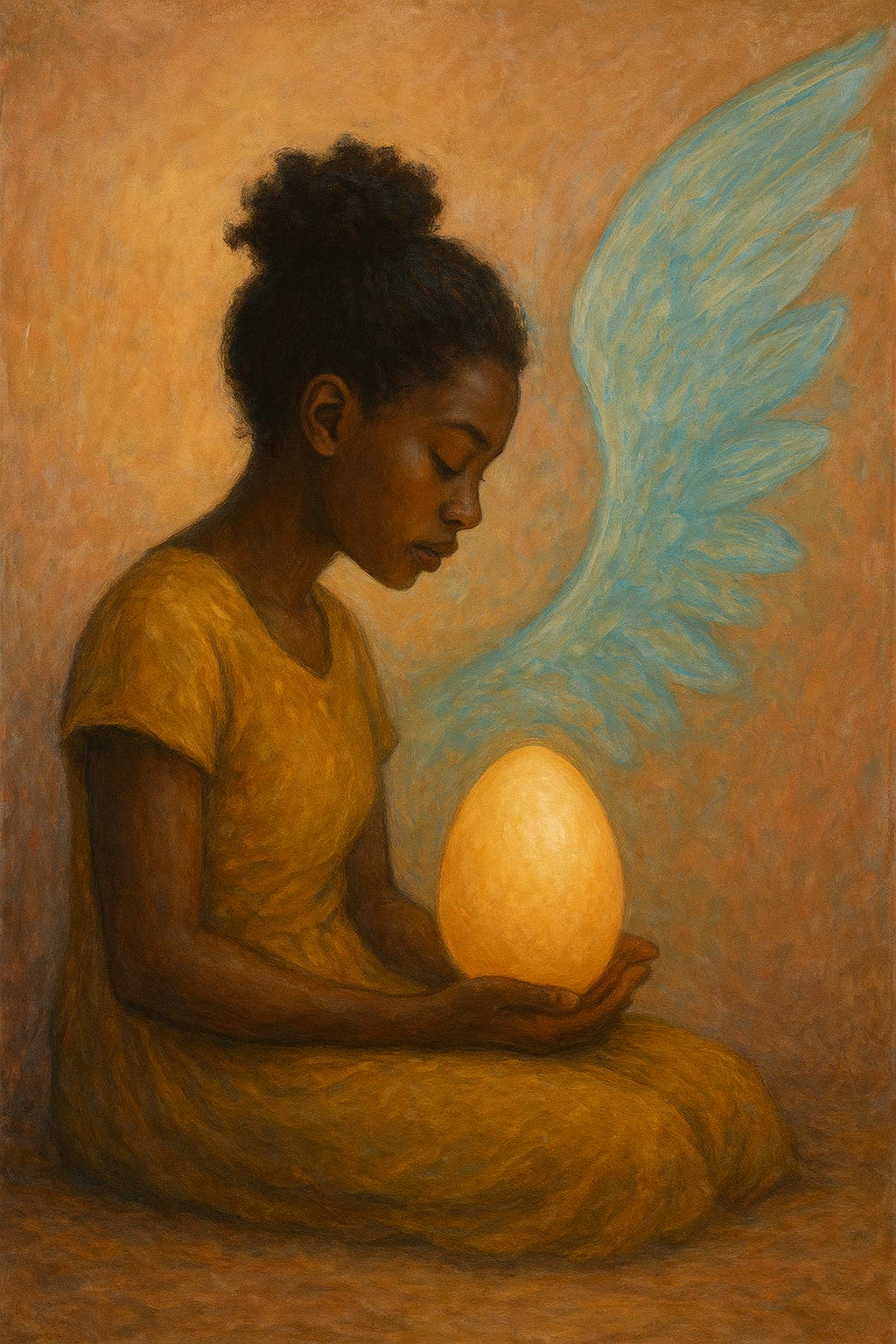
It’s been three years since then, and while many aspects of the novel remain embedded in my memory, one quote in particular still lingers with me:
“Without a name, something does not, cannot, will not exist.”
Recently, I had a conversation with a friend about names and the meanings they carry. She told me she wants to give her future children names that symbolise how deeply she loves them — and I thought that was so special and so important. We also spoke about choosing names with meaning, even if they’re considered “difficult” to pronounce, because naming someone is an act of power: it’s pouring something sacred into them.
That conversation brought me back to Ndlovu’s words — and inspired this poem.
P.S. I might write another piece about why this novel means so much to me as a reader, but for the purposes of this post, I’ll simply say that The Theory of Flight made me realise there is something truly special about finding home in a book — and in a story.
✦
Before the breath that baptised you into this world,
your name was already dancing
in your mother and father’s minds,
wrapped in ululations and whispered pearls of wisdom:
“Without a name, there is no being.
For what is not named is not known,
or remembered.”
So then your name was the first poem your people ever gave you.
It was their loudest act of love —
a declaration and a prophecy,
a story your ancestors told
long before your body came into being.
They called you Lesedi, because you brought light —
the same kind that once illuminated creation itself in Genesis 1:3.
You are Tatenda, because they had prayed,
and now, they give thanks for you.
It is Naledi, because you are the star
people follow when they forget who they are and where home is.
It is Nerudo, because love needed a body,
and so, it became you.
It is Anesu, because God is, and has always been, with us.
✦
I’ve always thought that naming someone requires both deep thought and a quiet kind of courage —
a deliberate way of saying, “You belong here, and you are known.”
To try to capture their essence in a few syllables feels like an act of faith —
a way of saying, “I see you already, even before the world does.”
✦
My act of faith will be teaching the world to say my children’s names in full.
To ask it to accommodate their consonants.
Even when it pauses or stumbles over their vowels, I will ask again.
But I will not teach my children to fold their names into corners —
to make themselves small for anyone’s comfort.
For their names were not meant to be easy,
they were meant to be true.
Through them, I will call strength into bone,
history into breath,
identity into the world.
They will exist boldly, take up space, carry memory.
And they will never forget that when their name is spoken,
the stars shift —
and the world remembers that they are here.
And long after they are gone,
their names will remain on someone else’s tongue —
a gentle reminder
that love once took form,
and called itself home.
I find the beauty behind African names is the thought and decisions behind them. A community coming together to profess their love for you.
WOW, what a beautiful piece Ano